
Who pays for facade work in a Maltese condominium
The external walls of a Maltese block belong to everyone in it, and the Condominium Act decides how the bill is divided, who calls the meeting and what majority a repaint needs. This is how a facade project gets decided, quoted and paid for — and what happens when one owner refuses.
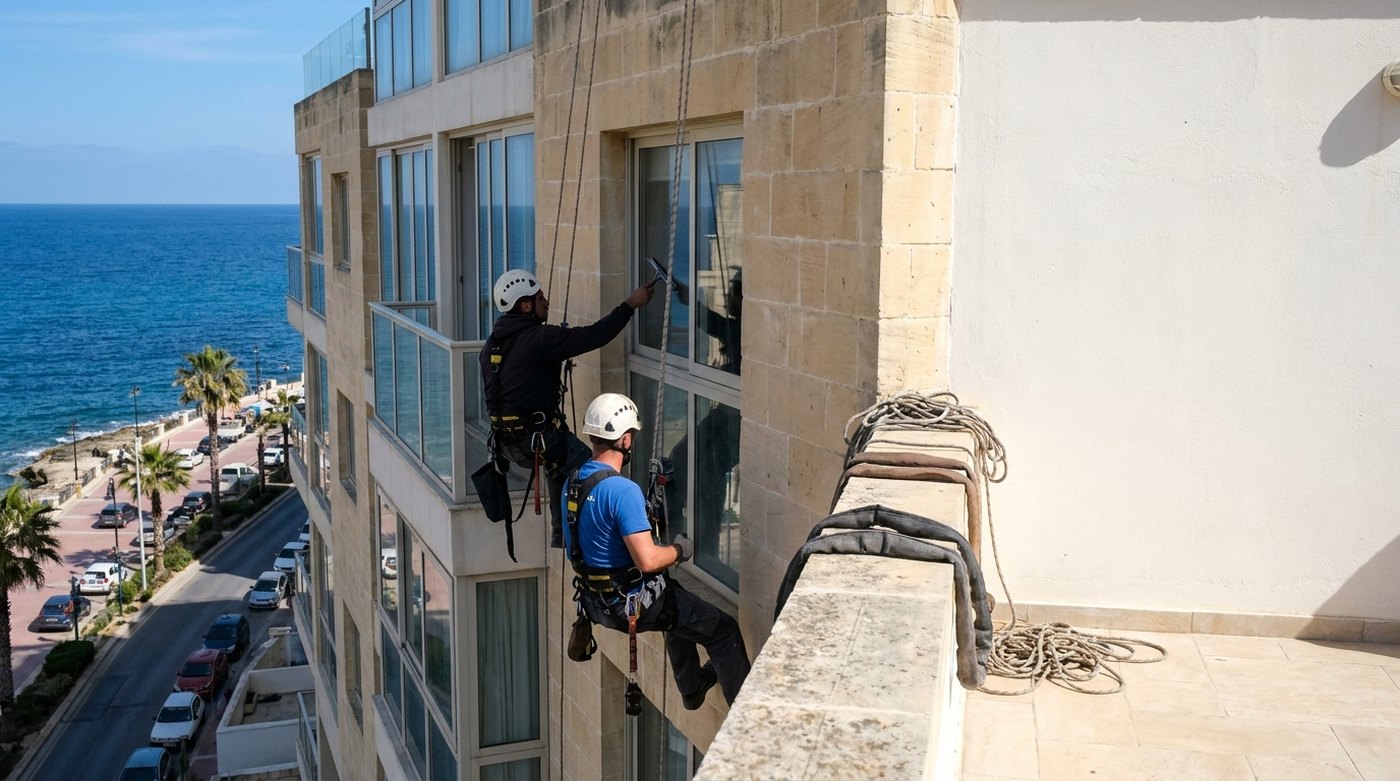
If you own an apartment in Malta or Gozo, you do not own the wall it sits behind. The Condominium Act, Cap. 398, treats the external walls of the building as a common part, alongside the other structural and shared elements of the block. That single point decides most arguments about facade work before they start: a spalling parapet, a stained render face or a failing paint system on the front elevation is not the problem of the owner whose balcony happens to be next to it. It is the block's problem, and the block pays.
What follows is how that actually works in practice — who decides, who pays what, what needs a unanimous vote, and what happens when someone refuses.
The facade is a common part
The provisions that matter for a facade project are clustered in articles 5, 8, 11, 15 and 22 of Cap. 398: what counts as a common part, how expenses are apportioned, when an administrator becomes compulsory, how decisions are taken and bind owners, and how disputes are resolved. Practitioner summaries of the Act make the same point in plainer terms — the external envelope, the roof, the entrance, the stairs and the shafts are shared, and the owner's exclusive property effectively stops at the internal face.
The practical consequence is that no individual owner can commission facade work on their own section of wall, and no individual owner can be made to pay for all of it because the defect is above their unit.
How the bill is split
The default rule is proportional: each owner contributes to the expenses of the common parts in proportion to the value of their unit, unless the deed provides otherwise. Two things follow from that.
First, read the deed before you read the Act. Many Maltese blocks — especially those sold in shell form, unit by unit, over several years — have deeds that allocate shares expressly, and where the deed speaks, it governs. A penthouse with a large terrace and a ground-floor unit with no facade exposure at all may carry very different shares, and those shares apply to a repaint just as they apply to lift maintenance.
Second, "by value" is not the same as "by number of apartments" and not the same as "by floor area". Buyers arriving from the UK who are used to a service charge percentage stated on the lease should expect to find the equivalent figure in the Maltese deed — but should check it is there, because if it is not, the statutory default takes over.
More than three owners means an administrator
Once a condominium has more than three owners, appointing an administrator is compulsory under the Act. This is the provision most often ignored in smaller blocks, and it matters for facade work specifically, because the administrator is the person who can lawfully convene the meeting, put the proposal, collect the contributions and instruct the contractor. Without one, there is no mechanism — just a WhatsApp group.
The administrator's job on a facade project is procedural rather than technical:
- Establish that the work is needed and identify what type of work it is — repair, or something that alters the building's appearance.
- Obtain quotes. Practitioner guidance treats three comparable quotes as the normal standard for major works, and it is also the simplest way for an administrator to show the meeting that the price was tested.
- Convene the meeting properly, with notice, and put the specific proposal and the specific figure to a vote.
- Minute the decision, the apportionment and the payment schedule.
- Order the work and account for the money.
What the meeting has to vote on, and by what majority
The Act distinguishes between keeping the building as it is and changing it.
| Work | Character | Vote |
|---|---|---|
| Cleaning the facade; repairing spalled render; replacing failed sealant; repainting in the existing colour and finish | Ordinary repair and maintenance | Decided at a properly convened meeting; binds all owners, including absentees and those who voted against |
| Repainting in a different colour; changing the finish or the visual character of the elevation | Alteration to the appearance of the building | Unanimity |
| Emergency works to prevent imminent damage | Administrator's function under the Act | Report to the owners; still accounted for |
The quorum and majority figures are set out in the Act itself and should be checked against the current text before the notice goes out. A resolution taken at a quorate, properly convened meeting binds the whole condominium — which is exactly why a resolution taken at an inquorate or improperly convened one is worth nothing and will be the first thing a non-paying owner points at.
The unanimity rule on appearance is the one that catches people. A block can vote through a full facade repair by majority and then discover it cannot vote through the new colour scheme it had in mind, because one owner in Gozo who has not visited since 2019 objects. Like-for-like is the path of least resistance.
The reserve fund
Practitioner guidance describes a reserve fund as the mechanism for major non-routine repairs — the category a facade project almost always falls into. A block that has been collecting into a reserve will be voting on how to spend money it already has. A block that has not will be voting on a special levy, and that is a materially harder meeting, because owners who are selling, letting or short of cash will all have reasons to defer. If your block has no reserve, the facade discussion is really two discussions, and it is worth separating them.
Comparing quotes that are not comparable
The Act says nothing about access methods, and neither do the practitioner sources. But the apportionment only works if the quotes describe the same job. Ask each contractor to state, in writing, what is included in the price and what is not: preparation and extent of repair versus coating only, what happens if more spalling is found once the surface is opened up, how long the building is disrupted, and whether the access element is priced separately. A quote that is cheaper because it excludes the access, or because it assumes half the repair area, will produce a variation later — and variations are apportioned the same way as the original bill, to owners who thought they had voted on a final figure.
When an owner will not pay
The debt belongs to the defaulting owner. The administrator is the person with standing to pursue it, and the Act provides for condominium proceedings to recover unpaid contributions. In the meantime the other owners usually have to bridge the gap, because the contractor is not a party to the dispute — so keep the paper trail tidy: notice of meeting, attendance, quorum, the resolution, the three quotes, the apportionment, the demand.
When the share itself is the problem
An owner who thinks the share allocated to them is unfair is not limited to paying under protest. The Act provides an arbitration route for condominium disputes, including disputes about apportionment. The sensible time to use it is before the work is ordered. Raising it after the job is finished does not make the argument wrong, but it does mean arguing about money that has already been spent.
One thing that does not carry over
Owners arriving from the UK or elsewhere in the EU often assume their home jurisdiction's structure applies here: a managing agent under a lease, a section 20 consultation, a leasehold tribunal. None of that is the Maltese framework. The framework is Cap. 398, the deed, and the administrator — and the administrator is compulsory above three owners, not a service the block may choose to buy in. Separately, and outside these sources entirely, the access arrangements for the work itself sit under Maltese occupational health and safety law and, where the pavement is affected, local council permitting. Those are different questions with different answers, and the condominium resolution does not settle them.
Common questions
- Our block has four apartments and nobody has ever appointed an administrator. Is that a problem?
- Yes. Under the Condominium Act, once a condominium has more than three owners the appointment of an administrator is compulsory, not optional. Until one is appointed there is nobody with authority to convene the meeting, collect contributions or sign a contractor's order on behalf of the block, which is why facade projects in small unadministered buildings tend to stall at the discussion stage.
- Can a majority of owners force me to pay for a repaint in a different colour?
- No. Repair and maintenance of a common part — cleaning, patching, replacing like for like — can be decided by a vote at a properly convened meeting and binds everyone, including owners who voted against and owners who did not attend. Work that changes the appearance of the building is treated differently and requires unanimity. If one owner objects to the new colour, the lawful options are the existing colour or no repaint.
- One owner refuses to pay their share. Do the rest of us have to cover it?
- In cash-flow terms, usually yes, at least temporarily, because the contractor has to be paid. Legally, no: the debt stays with the defaulting owner. The administrator is the person with standing to pursue it, and the Act provides for condominium proceedings to recover contributions. That is a reason to get the resolution, the quotes and the apportionment minuted properly — recovery is easier when the decision is documented.
- I think my share of the facade bill is too big. What can I do?
- The Act's default is that expenses are shared in proportion to the value of each unit, unless the deed provides otherwise. If you believe the share allocated to you is unfair, the Act provides an arbitration route for disputes of this kind rather than leaving you to either pay or be sued. Raise it before the work is ordered if you can — arbitrating an apportionment after the scaffolding is down is harder work.
What we could not establish
- None of these sources gives figures for what facade repair, cleaning or repainting costs in Malta, or how rope access compares with scaffolding on price. They are legal and management sources, not pricing sources.
- These are condominium-law sources only. None of them deals with permits for scaffolding, hoarding or a skip on a public pavement, or with work-at-height duties under Maltese occupational health and safety law. Those sit outside Cap. 398 and need to be checked separately.
- Nothing here establishes how much must be held in a reserve fund, how it is calculated, or what happens to it when a unit is sold.
- Nothing here establishes how the 'value' of a unit is fixed when the deed is silent on shares — a live question in blocks sold in shell form where the deeds were drafted unit by unit.
- Nothing here establishes timescales or costs for condominium arbitration, or whether an arbitration award suspends the obligation to pay in the meantime.
Sources
- Condominium Act, Cap. 398 — legislation.mt · read 2026-09-21
- Malta Condominium and Common Parts: What Owners Should Check — All About Malta · read 2026-09-21
- Condominium Proceedings in Malta — Chetcuti Cauchi Advocates · read 2026-09-21
- The Definitive Guide to Condominium Management in Malta — Victor Estate · read 2026-09-21
Want this costed properly?
The calculator gives you a figure in a minute. A site visit gives you a fixed price.
Book a free survey