
Malta's work-at-height rules for facade work
A plain reading of the two subsidiary laws that govern facade work at height in Malta — the work equipment rules on rope access and the construction site rules on fall protection — plus the 424→646 renumbering and OHSA's 2025 inspection findings.
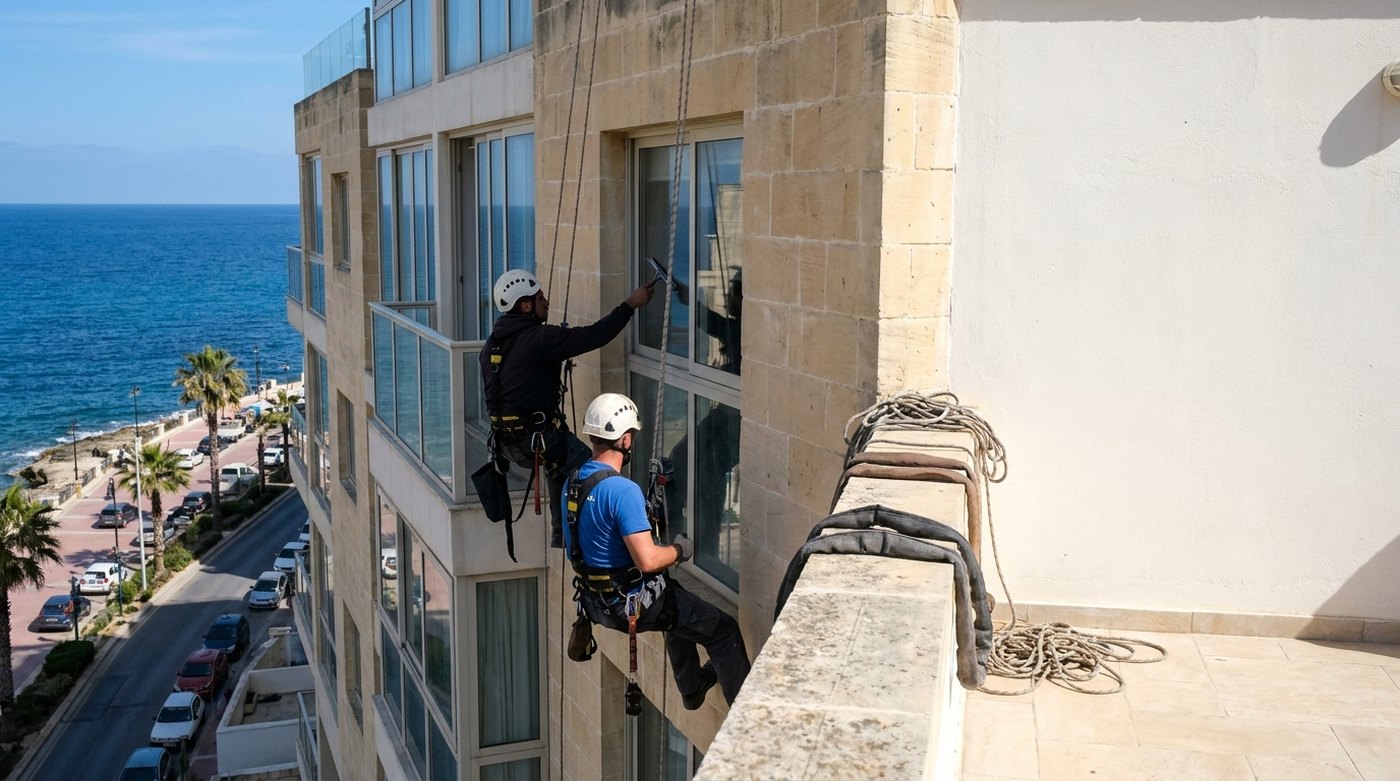
Most people commissioning facade work in Malta have never read the rules that govern it, and there is a reason for that: they were renumbered. If you arrived from the UK you will also be looking for the HSE and for something resembling the Work at Height Regulations 2005. Neither applies. The regulator here is the Occupational Health and Safety Authority (OHSA), and the two instruments that decide how someone may hang off the side of your building are subsidiary legislation, not primary law.
The 424 → 646 renumbering
Older method statements, older insurance schedules and a good deal of older advice still cite subsidiary legislation under Chapter 424. OHSA's legislation page now lists the current instruments under Chapter 646. The substance carried across; the shelf mark changed. For facade work the two that matter are:
| Instrument | Short name | What it governs here |
|---|---|---|
| S.L. 646.24 | Work Equipment (Minimum Safety and Health Requirements) Regulations | Rope access and positioning techniques, ladders, work equipment for temporary work at height |
| S.L. 646.27 | Construction Sites Regulations (L.N. 52 of 2025) | Falls from a height on construction sites, scaffolding |
If a contractor sends you a document citing S.L. 424.xx, that is not automatically a red flag — plenty of boilerplate has simply not been refreshed — but ask for the current citation. You want to be able to open the text and read it, and the version you will find at legislation.mt is the 646 one.
S.L. 646.27: collective protection comes first
Paragraph 5 of the Schedule to S.L. 646.27 deals with falls from a height. The structure is a hierarchy, and the hierarchy is the whole point.
Falls are to be prevented by collective protection measures — physically enclosing or guarding the place of work, so that nobody can fall regardless of what they clip on to. Guard-rails, working platforms, edge protection, nets. Only where collective protection is not reasonably practicable, given the nature of the work, does the law permit personal protective measures such as harnesses and lines.
This matters for a building owner because it inverts the question most people ask. The question is not "is rope access allowed?" It is "can this particular job be done from a protected platform, and if not, why not?" A competent contractor should be able to answer that for your building specifically — a narrow Valletta street with no pavement to stand a tower on, a set-back terrace with no anchor for a platform, a shell-form block where the facade is being finished before any permanent edge protection exists — rather than simply asserting a preference.
Paragraph 6.3 of the same Schedule addresses scaffolding certification. If scaffolding is the answer, it is not enough that it looks solid: the regulations require it to be checked and certified by a competent person. Ask to see that certificate before anyone climbs it, and ask who signed it.
S.L. 646.24: the conditions attached to rope access
Where rope access and positioning techniques are used, the Schedule to S.L. 646.24 — paragraphs 5.2 to 5.7 and paragraph 6 — attaches specific conditions. In substance:
- Two separately anchored ropes. A working line, used for access, descent and support, and a separate safety line as a back-up. Separately anchored means what it says: one anchor failing must not take both lines.
- A harness attached to the safety line. The worker's harness is connected to the back-up, not only to the line carrying their weight.
- Self-locking devices. The working line carries a safe means of ascent and descent and a self-locking system that arrests the worker if they lose control. The safety line carries a mobile fall protection device that follows the worker's movements.
- Tools tethered. Tools and other accessories are to be secured to the harness or the seat, or by other suitable means. This is as much about the pavement below as about the technician.
- Rescue planned in advance. The work must be properly planned and supervised so that a worker can be rescued immediately if something goes wrong. Waiting for the fire service is not a rescue plan; a suspended worker does not have that long.
- Training specific to the operation, including rescue procedures.
There is a narrow exception contemplated for the second rope, where using it would make the work more dangerous — but it is an exception, subject to a risk assessment and compensating measures, not a general licence to work on one line. If a quotation describes a single-rope method, that is a question to put in writing.
What OHSA found in 2025
The OHSA Annual Report 2025 records more than 23,700 inspections. Its infringements table, Table 9, shows fall protection non-compliant on 23% of inspected sites. Nine workplace deaths were recorded in the year.
Roughly one site in four inspected had something wrong with its fall protection. That is the base rate you are contracting against. It is not an argument that contractors are careless as a class; it is an argument that compliance is not the default and you should check rather than assume.
Your position as the person commissioning the work
The sources cited here set out the technical requirements. They do not, in the paragraphs cited, resolve how liability is apportioned between an owner, a condominium administrator, a facilities manager and a contractor — that lives in the body of S.L. 646.27 and is worth reading before you sign anything. What is clear is practical rather than legal: the work happens on your building, the ropes hang over your entrance, and if OHSA inspects, it inspects your site.
Before work starts, ask for and keep:
- A written risk assessment and method statement for your building, naming the anchor points to be used.
- The justification for personal rather than collective protection, if rope access is proposed.
- The rescue plan, including who performs the rescue and how long it takes.
- Evidence of the technicians' training for the operations envisaged, including rescue.
- If scaffolding is used, the paragraph 6.3 certification from the competent person who checked it.
Two Maltese specifics are worth flagging even though these regulations are silent on them. First, on a condominium the facade is usually common property, and who may authorise works on it is a matter for condominium law, not for OHSA — the safety rules will not tell you whether you needed a resolution. Second, in Gozo everything arrives by ferry, scaffolding included; the practical cost and delay of the collective-protection option is different there, which is a commercial fact, not a legal one. The hierarchy in paragraph 5 still applies on both islands.
Common questions
- Is scaffolding legally required for facade work in Malta, or can rope access be used?
- Neither is mandated by name. S.L. 646.27 requires that falls from a height be prevented by collective protection — guard-rails, platforms, nets — and allows personal protection such as harnesses where collective measures are not reasonably practicable. Rope access is then permitted under S.L. 646.24 provided its own conditions are met, including two separately anchored ropes, a self-locking device, tethered tools and a rescue plan.
- My quote or method statement cites S.L. 424.xx. Is it out of date?
- Not necessarily wrong, but the numbering has moved. OHSA's legislation page lists the current instruments under Chapter 646, so what was cited as S.L. 424.xx is now found as S.L. 646.xx — the work equipment rules as S.L. 646.24 and the construction site rules as S.L. 646.27 (L.N. 52 of 2025). Ask for the citation to be updated so you can check the text yourself.
- Can a rope access technician ever work on a single rope?
- S.L. 646.24 is built around two separately anchored lines — a working line and a safety line. The Schedule contemplates a narrow exception where using a second line would make the work more dangerous, and only with appropriate compensating measures. Treat any single-rope proposal as something the contractor must justify in writing in the risk assessment, not as a normal working method.
- What do OHSA's 2025 figures say about fall protection?
- The OHSA Annual Report 2025 records more than 23,700 inspections. Its infringements table (Table 9) shows fall protection non-compliant on 23% of inspected sites, and nine workplace deaths were recorded in the year.
What we could not establish
- The four sources cited here do not set out how duties are split between the client, the project supervisor and the contractor under the body of S.L. 646.27 — only the Schedule's technical requirements are cited. Anyone commissioning works should read the duty-holder articles of the regulations themselves.
- Neither instrument names a training or certification scheme. IRATA, or any other body, is not mentioned in the sources used here, so no source consulted establishes that a particular certificate satisfies the training requirement.
- Council or Transport Malta permits for scaffolding, hoardings or pavement occupation are not covered by these sources. That is a separate permitting question from the health and safety one.
- The Condominium Act (Cap. 398) and who within a condominium may authorise works on common parts are outside these four sources. Nothing here tells you whether an administrator can commission facade work without a general meeting resolution.
- No source consulted gives a breakdown of the nine 2025 fatalities by cause or sector, so it cannot be said here how many involved falls from height.
- No source consulted sets any price, rate or cost for scaffolding or rope access work.
Sources
- S.L. 646.24 Work Equipment (Minimum Safety and Health Requirements) Regulations — legislation.mt · read 2026-09-21
- S.L. 646.27 Construction Sites Regulations (L.N. 52 of 2025) — legislation.mt · read 2026-09-21
- OHSA Annual Report 2025 — OHSA · read 2026-09-21
- Legal & Policy / Legislation | OHSA — OHSA · read 2026-09-21
Want this costed properly?
The calculator gives you a figure in a minute. A site visit gives you a fixed price.
Book a free survey