
IRATA levels explained: why a rope team is never one person
Level 1 works under supervision, Level 2 has a thousand logged hours behind them, and only a Level 3 can supervise a site. The code of practice forbids lone working and Maltese law requires that a suspended worker can be rescued immediately — which is why a quote for a single technician is a warning sign.
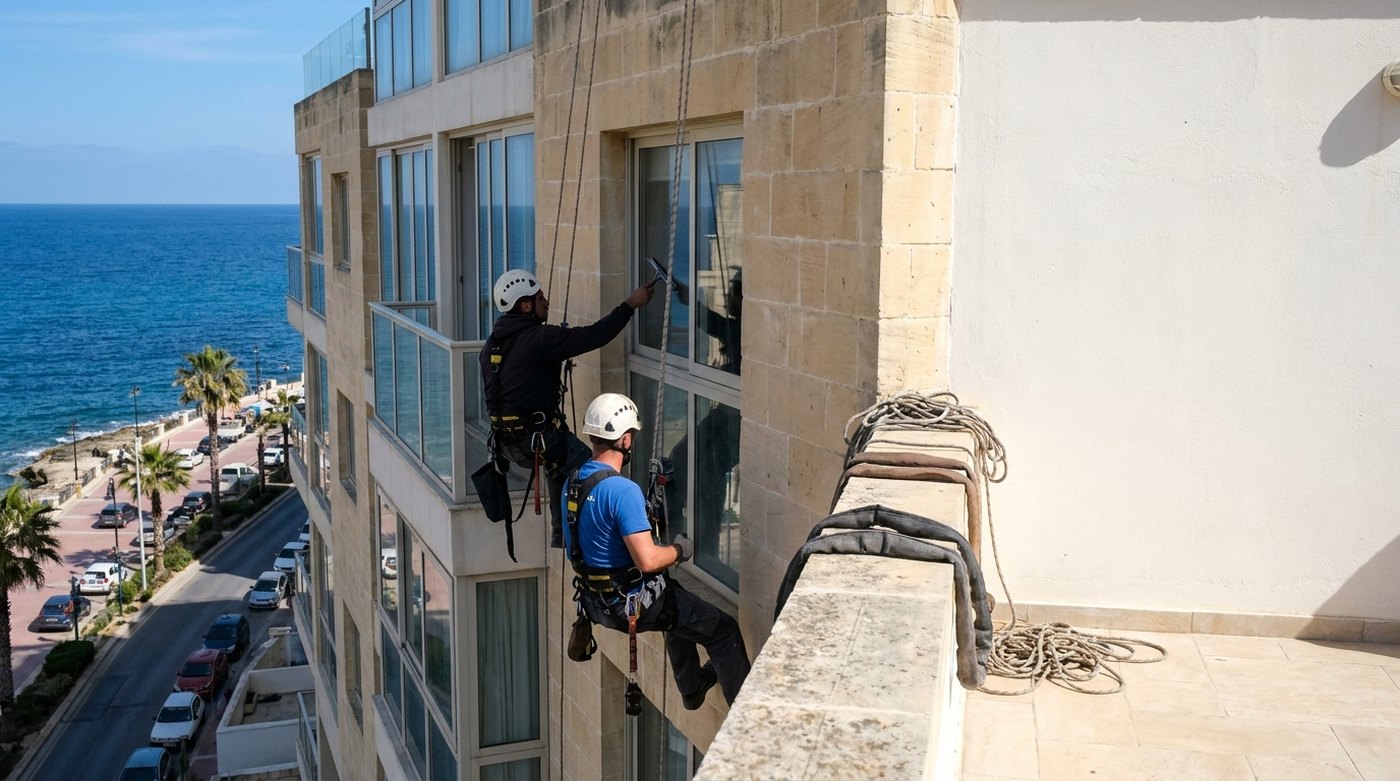
Most people commissioning work on a façade in Malta have commissioned scaffolding before. Scaffolding has a shape you can picture: a crew erects it, trades come and go for weeks, someone dismantles it. Rope access has a different shape, and the part that surprises clients most is the headcount. There is no such thing as a one-person rope job. Not a small one, not a quick one, not a single balcony.
That is not a preference. It is written into both the industry code and Maltese subsidiary legislation, and it is the single easiest thing for a building owner to check.
The three levels, and what separates them
IRATA certification runs in three grades. The difference between them is not enthusiasm or seniority in the informal sense — it is logged hours, elapsed time and assessed competence.
| Level | Minimum experience before assessment at that grade | Works under supervision | May supervise a site |
|---|---|---|---|
| Level 1 | Entry grade — no prior rope access hours required | Yes | No |
| Level 2 | 1,000 hours and 12 months as a Level 1 | Yes | No |
| Level 3 | A further 1,000 hours and 12 months as a Level 2 — 2,000 hours and two years in total | — | Yes |
A Level 1 can perform a range of rope access manoeuvres and carry out the work itself, under the supervision of a Level 3. That is the whole scope. A Level 1 is not a lesser technician for simple jobs; a Level 1 is a technician who is not permitted to be unsupervised.
A Level 2 has the thousand hours and the year, and adds rigging and more involved rescue capability. A Level 2 can do considerably more than a Level 1 — and still cannot supervise.
A Level 3 has the full two thousand hours and two years, is required to hold a current first aid certificate, and is the only grade that can act as the rope access supervisor on site. The Level 3 is responsible for the safe system of work, the rigging, the rescue plan and the oversight of everyone else on rope.
The hours matter because they are cumulative and elapsed-time-bound. You cannot compress 1,000 hours into a busy quarter and sit the Level 2 assessment early; the twelve months has to pass as well. That is deliberate.
Why the minimum team is two
The IRATA International Code of Practice is direct about it: lone working is not allowed. IRATA's own FAQs describe the minimum arrangement as a team of two, one of whom is a Level 3.
The reason is rescue. A rope access technician who becomes incapacitated while suspended cannot self-rescue, and suspension is time-critical. The second person on site is not a spectator, not a runner, not someone to hold the bottom of the rope. The second person is the rescue capability. That is why an untrained ground hand does not satisfy the requirement — the minimum team is two rope access technicians, with a Level 3 among them.
It follows that a Level 1 cannot be sent to a job alone under any reading of the code, because a Level 1 must be supervised by a Level 3, and the Level 3 has to be there to supervise. A Level 2 alone fails the same test. Even a Level 3 alone fails, because lone working is not allowed.
What Maltese law adds
British arrivals often reach for HSE guidance out of habit. The instrument that binds here is Maltese: S.L. 646.24, the Work Equipment Regulations. Paragraph 6 of its Schedule deals with work using ropes and positioning techniques, and two of its requirements decide this question.
First, the work must be properly planned and supervised, so that a worker can be rescued immediately in an emergency. "Immediately" is the operative word. A plan that involves telephoning for outside help and waiting is not a plan that meets that wording.
Second, workers must receive adequate and appropriate training specific to the operations envisaged — in particular, rescue procedures.
Note what the regulation does not do. It does not name IRATA. It sets no hour thresholds and issues no cards. The grade structure above is IRATA's, not Malta's. But a contractor who cannot show planning, supervision and trained rescue capability has a problem under Maltese law entirely independent of which scheme they belong to — and a two-person team with a certified supervisor is the ordinary way of demonstrating all three at once.
Why a one-technician quote is a warning sign
If a quote names one person, one of a small number of things is true, and none of them is good:
- The contractor intends to send one person, in which case the job is non-compliant before anyone leaves the van.
- The contractor intends to send two but has priced one, in which case the price you have been given is not the price of the job.
- The contractor intends to send a second person who is not a rope access technician, in which case there is no rescue capability on site.
The practical consequence for a condominium administrator or hotel facilities manager is that the cheapest quote in a stack is sometimes cheap because it is missing a person. Comparing it against a compliant quote is comparing two different scopes of work. If you take one thing from this article, take the habit of asking how many technicians will be on site and at what grades, and putting the answer in writing before you sign anything.
What to ask to see
Ask before the job, not on the morning of it. Four checks, all of which take a minute each:
- The certificates themselves, for every technician who will be on site. IRATA certification is valid for three years. Check the name, check the grade, check the expiry date.
- Which named person is the Level 3. There must be one, and they must be on site — not reachable by phone from another job in Gozo.
- The Level 3's current first aid certificate. It is a requirement of the grade, so it should exist.
- The rescue plan for your building specifically. Not a generic document. Paragraph 6 requires supervision such that rescue is immediate, which means someone has thought about your particular roof, your particular anchor arrangement and how a casualty comes down.
Hours are recorded in a technician's logbook as they are worked; that is the mechanism behind the 1,000- and 2,000-hour thresholds. The sources read here do not say a client is entitled to inspect a logbook, so treat the certificate as the document you are owed and the logbook as a courtesy if offered.
A note on what this article does not settle
Team composition and certification are one layer. Whether the works fall on common parts and therefore need the condominium's authority, whether a local council permit is needed for anything placed on a pavement, and who is entitled to commission the work in a shell-form or mixed-ownership block are separate questions governed by separate law. None of the three documents behind this article speaks to them, and this article should not be read as though it does. What it does settle is narrower and harder: a rope access job in Malta or Gozo is a team of at least two, one of whom holds Level 3, and a quote that says otherwise is telling you something.
Common questions
- Can one IRATA technician do a small job alone?
- No. The IRATA International Code of Practice states that lone working is not allowed, and IRATA's own FAQs describe the minimum working arrangement as a team of two that includes a Level 3 supervisor. A single technician on site is not a cheaper version of a compliant job; it is a different thing altogether.
- Who is allowed to supervise a rope access site?
- Only a Level 3. Levels 1 and 2 both work under the supervision of a Level 3, who is also required to hold a current first aid certificate. A Level 2 is a more capable technician — rigging, more complex rescues — but is not a supervisor.
- How long is an IRATA certificate valid?
- Three years, according to IRATA's FAQs. Ask to see the certificate or card, check the level, check the name against the person standing in front of you, and check the expiry date. An expired card is not a formality.
- Does Maltese law require IRATA specifically?
- S.L. 646.24 does not name IRATA or any other scheme. What paragraph 6 of its Schedule requires is that rope work be properly planned and supervised so that a worker can be rescued immediately in an emergency, and that workers receive adequate training specific to the operations, in particular rescue procedures. IRATA's level structure is one documented way of evidencing that; the legal duty stands regardless of which scheme a contractor uses.
What we could not establish
- Neither IRATA document read here gives a fixed maximum number of technicians that one Level 3 may supervise on a single site; the requirement is framed as effective supervision rather than a published ratio.
- The sources do not describe a public register or verification service a building owner could use to check an IRATA certificate number independently.
- S.L. 646.24 sets no hour thresholds, no grade structure and no card scheme of its own — so there is no Maltese legal definition of 'Level 1' to test a contractor against.
- Nothing in these three sources addresses the Condominium Act (Cap. 398), common parts, or local council permits for occupying a pavement. Those are separate questions and are not settled here.
- No published figures exist, in these sources, on how many rope access jobs in Malta and Gozo are actually run with a compliant two-person team.
Sources
- IRATA International Code of Practice (TC-102ENG) — IRATA International · read 2026-09-21
- FAQs | IRATA International — IRATA International · read 2026-09-21
- S.L. 646.24 Work Equipment Regulations, Schedule para 6 — legislation.mt · read 2026-09-21
Want this costed properly?
The calculator gives you a figure in a minute. A site visit gives you a fixed price.
Book a free survey