
Fixing a leaking facade joint without scaffolding
Water at a fourth-floor window head is usually a failed joint, not a failed wall. Here is how the leak is traced, how the sealant is replaced from rope, and why a two-hour job still requires two ropes under Maltese law.
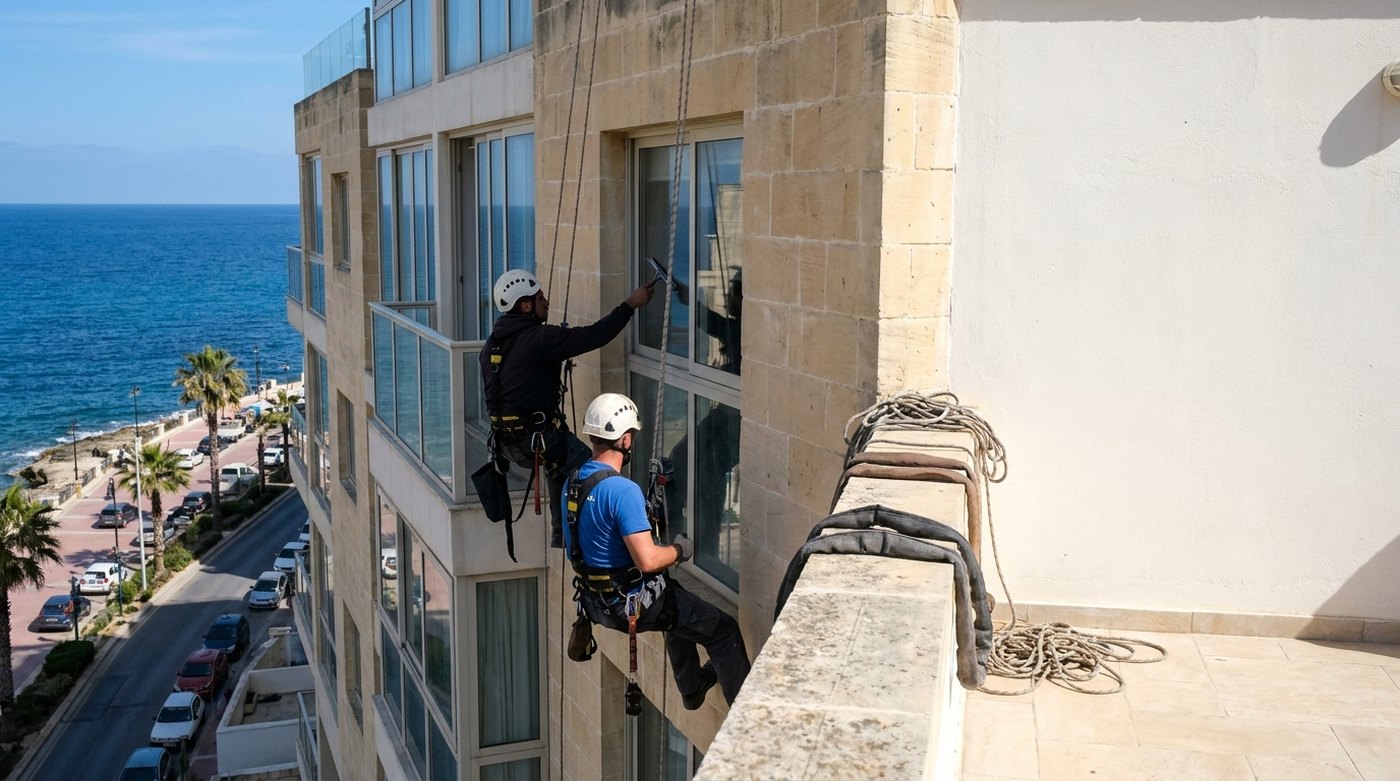
A stain appears on the inside face of a fourth-floor wall, under a window head, after the first serious rain of the autumn. By February it is a patch of blown plaster and a smell. The owner's instinct — particularly if they have come from the UK — is to price scaffolding, because at home that is what happens when something high up needs fixing, and the cost and the two-week programme are accepted as the price of the job.
For a single failed joint, that is the wrong shape of solution. The actual work is a few linear metres of sealant. Everything else is access.
What is usually leaking
Water gets in through the gaps between things, not through the middle of things. On a typical Maltese apartment block the candidates are:
- The joint between the aluminium window frame and the stone or render reveal. The commonest single cause. The sealant has gone hard, shrunk away from one edge and opened a hairline channel at the head, where wind-driven rain is worst.
- A movement joint running vertically or horizontally across the elevation, where the original sealant has split or debonded.
- The head detail above the window — a drip, a sill nose, a cill joint — where water is being led to the wall instead of away from it.
- Failed pointing in the limestone itself, which is a different repair with a different cost, and is dealt with below.
The point of naming these separately is that they look identical from inside the flat. The stain tells you where the water arrived, not where it came in. Water can travel a metre or more along the underside of a lintel before it shows.
Tracing the leak from rope
A technician on rope works down the elevation above the stain and checks, in order:
- The joint by hand and by eye. Hard, chalky sealant that has lost its elasticity; a bead that has pulled away from the frame on one side; a joint that was over-painted and has cracked along the paint line.
- The geometry. Which way does the prevailing weather hit this face? Is there a balcony above channelling run-off to one corner? Is a downpipe or an air-conditioning condensate line discharging onto the wall?
- Everything above the stain, not just level with it. The failed joint is frequently one or two floors higher than the damage inside.
- A water test where it is inconclusive. Wetting a defined area from rope while someone watches inside is the only way to separate two adjacent candidates.
This diagnostic stage is the part that scaffolding does badly and rope does well. On rope, a technician can be at the head of one window, then at the corner of the movement joint six metres to the left, in a few minutes, without a platform having to exist across both.
The repair
Sealant replacement is not topping up. A bead applied over failed sealant fails again, faster, because it is bonded to a material that is already letting go.
- Cut out the old sealant completely, back to sound substrate on both faces of the joint.
- Clean and dry the joint. Dust and residue are the usual reason a new bead debonds within a season.
- Prime where the substrate requires it, and fit backing rod where the joint depth needs controlling so the sealant can move.
- Gun the new bead and tool it, so it is in contact with both joint faces along its full length.
- Check the detail above it. Resealing a window head while leaving a balcony above discharging onto the same spot buys one winter.
On a single window head or a short run of movement joint, this is hours of work, not days. The honest way to describe such a job is that the material cost is trivial, the sealant work is short, and the majority of what is being paid for is being safely in position at height.
Why a small job still needs two ropes
This is the part that surprises people used to a UK scaffold-and-sign-off culture. Malta's rules do not scale down with the job.
The Schedule to the Work Equipment Regulations, S.L. 646.24, at paragraph 6, sets the rope-access requirement: a working line and a separate safety line, each with its own anchor. That requirement applies regardless of the size of the job. There is no two-hour exemption, no one-window exemption, and no "it's only a bit of mastic" exemption.
The practical consequence follows from the rule rather than being separate to it. A technician suspended on two correctly anchored ropes is protected against equipment failure, but not against becoming unable to descend. That is why a rope job — even a short one — is planned around someone being able to reach and lower the person on the rope, which in practice means a second trained technician present rather than a phone call to the fire service. If you are quoted a facade repair by a single person working off one line, you are being quoted something that does not comply.
Two other Maltese points that differ from UK expectations:
- The enforcement body here is the OHSA, not the HSE. UK guidance notes, ACOPs and HSE leaflets are not the legal instrument that applies to your building.
- Scaffolding on a pavement or street generally engages the local council for occupation of public space. Rope access, working from anchors on the roof and requiring only a small exclusion zone below, avoids most of that administrative chain. Our sources here do not establish the fees or lead times either way, so ask the council directly rather than relying on a figure from a blog.
What it costs, and what nobody publishes
There is no published Maltese per-linear-metre rate for facade joint sealant work. We looked. The nearest labelled figure is from a UK sealant contractor's 2026 pricing guide, which puts facade joint work at £5–10 per linear metre and states that this excludes access.
Treat that as an order of magnitude and nothing more. It is a UK labour market, in sterling, and the excluded item — access — is the larger half of the job on a fourth-floor elevation in Malta. Anyone quoting you a Maltese sealant price per metre is quoting their own rate, not a published benchmark.
For scale on the other side of the same facade, Darna's property maintenance cost guide puts limestone facade re-pointing and patching at €1,000–5,000. That is a different job: stone repair across an area, not a bead of sealant along a joint. It is useful context because it marks the point at which the diagnosis matters financially. If the leak is a failed joint, you are in the low hundreds plus access. If the leak is failed stone and pointing across the elevation, you are in Darna's range.
Condominium and ownership complications
Two Maltese realities decide who pays and who authorises.
Common parts. Under the Condominium Act, Cap. 398, the facade of an apartment block is generally common, not the private property of the owner whose ceiling is stained. That means the repair is normally a condominium decision and a condominium expense, even though the damage is visible in one flat only. An owner who instructs a contractor privately, without going through the administrator, may be paying for work on something they do not own. Get the instruction in the right name before the ropes are rigged.
Shell form. Property in Malta is routinely sold in shell form, with the buyer finishing internally. Where a block was completed unit by unit over years, window installations and their perimeter sealing are often the work of different trades, done to different standards, at different dates. A single failed joint on a facade like that is a reasonable thing to fix in isolation. Four failed joints in the same corner of the block is a pattern, and worth surveying the whole elevation before repairing one of them.
Gozo. Every delivery crosses on the ferry. For a sealant job that means little — the consumables fit in a van — but it is the reason a scaffold-based alternative in Gozo carries a cost that has nothing to do with the repair itself.
What to ask for in a quote
- Which joint or joints have been identified as the source, and how that was established.
- Whether the work is cut-out-and-replace or overbeading.
- Confirmation of two-rope working and the rescue arrangement, per the Schedule to S.L. 646.24.
- Whether the details above the repair — balcony drainage, condensate lines, sill noses — were inspected at the same time.
- Whether the instruction is being taken from the condominium administrator, where the facade is a common part.
Common questions
- Do I really need scaffolding to reseal one window on the fourth floor?
- Not usually. A single failed joint at a window head or a length of movement joint is a rope-access job measured in hours, because the work is confined to a few linear metres and needs one technician in position rather than a working platform across the whole elevation. Scaffolding becomes the sensible answer when the work is spread across the elevation, when heavy materials or many trades need a platform, or when the facade cannot be safely accessed from above.
- Why do two technicians turn up for a two-hour job?
- Because the Schedule to S.L. 646.24 (the Work Equipment Regulations) applies its two-rope requirement regardless of how small the job is — a working line and a separate safety line, each independently anchored. A technician suspended alone on two ropes still cannot bring himself down if he is injured or unwell, so the practical consequence of the rule is a second person at the top or on an adjacent rope. The job size does not change the obligation.
- How much sealant work will I actually be paying for?
- No Maltese per-linear-metre rate is published. The closest labelled figure is a UK guide that puts facade joint sealant work at £5–10 per linear metre, explicitly excluding access. That is a UK labour market and a UK currency, so treat it as an order of magnitude rather than a quote, and note that in Malta the access is a separate and significant part of the cost.
What we could not establish
- No Maltese published per-linear-metre rate for facade joint sealant work exists in our sources. The only labelled rate available is UK (£5–10/lm, access excluded) and should not be read as a Maltese price.
- Our source for the two-rope requirement is the Schedule to S.L. 646.24. We have not cited a separate provision setting out the form or contents of a written rescue plan, so the Schedule and the OHSA guidance should be read directly rather than relying on this article for that detail.
- Nobody publishes a Maltese figure for how long a facade sealant repair lasts in coastal salt exposure, or how often joints on a seafront elevation need redoing compared with an inland one.
- Our sources do not establish local council permit fees, lead times or conditions for scaffolding or hoardings on a pavement, nor any rope-access equivalent.
- The Darna €1,000–5,000 figure is for limestone facade re-pointing and patching. It is not a sealant figure and our sources do not say what share of that range is access, materials or labour.
Sources
- How Much Does a Mastic Man Charge? UK Pricing Guide for 2026 — Pioneer Sealants (UK) · read 2026-09-21
- Property Maintenance Costs in Malta — Darna · read 2026-09-21
- S.L. 646.24 Work Equipment Regulations, Schedule para 6 — legislation.mt · read 2026-09-21
Want this costed properly?
The calculator gives you a figure in a minute. A site visit gives you a fixed price.
Book a free survey