
Cleaning a Maltese apartment block facade: how it is priced
Published Maltese window-cleaning prices are per-visit figures for flats and terraces. Whole-block facade work is quoted per project, and this explains what the rope team is actually counting when it prices one.
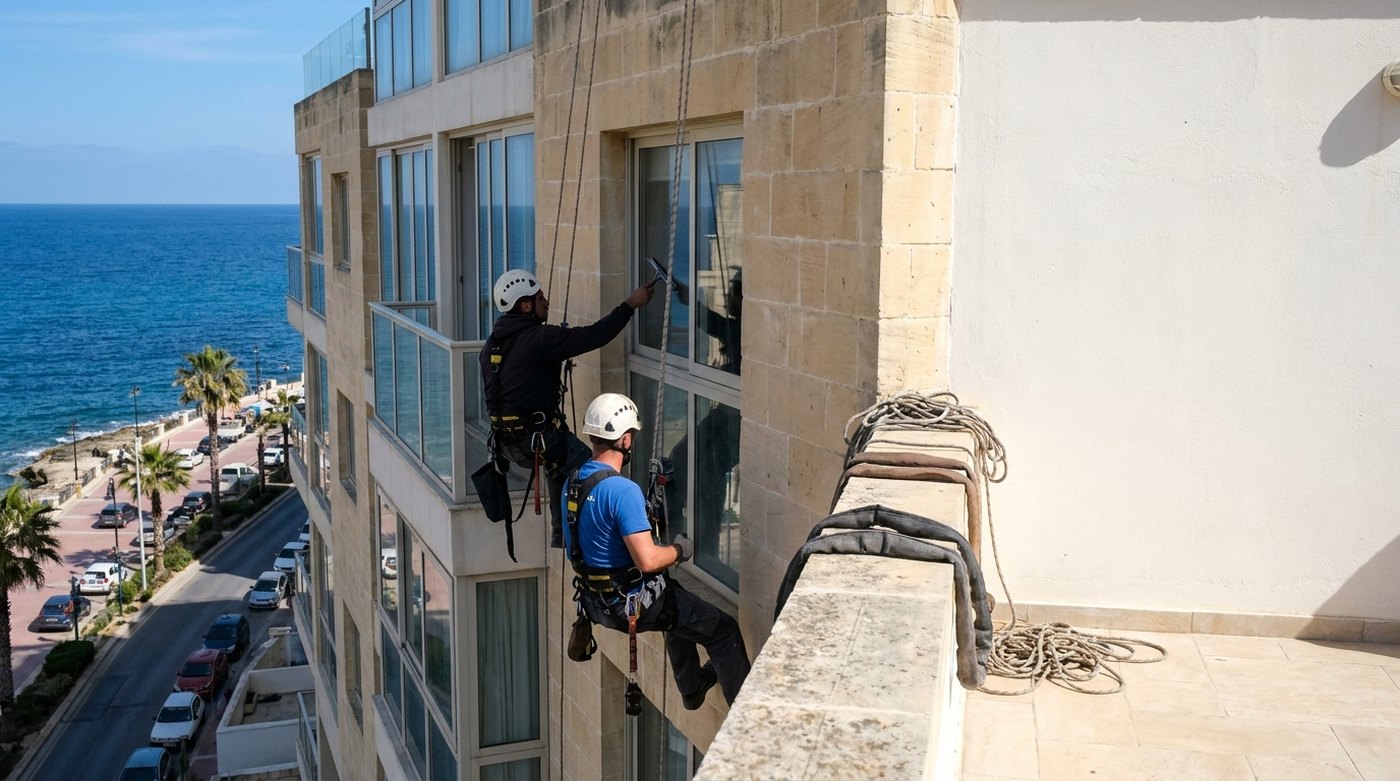
Most price information published about window and facade cleaning in Malta is domestic. It describes one flat, one terrace, one visit. Rozie's Malta guides put high-rise exterior window work at €80–200+ per visit, and its terrace guide adds two modifiers: an access charge for work above the third floor, and a locality premium of 10–20% in Sliema and St Julian's. Those are useful numbers if you own a top-floor apartment in Gzira. They are close to useless if you administer the whole building.
That is not an accident of reporting. Rozie's own guide states that commercial work is quoted per project. Spic & Span, a Maltese rope-access window and facade cleaner operating since 2010, publishes no prices at all — quotes only. Nobody in this market publishes a block rate, because there is no unit that survives contact with the next building.
This article explains what a rope team is actually counting when it prices your block, so that you can read a quote rather than just compare two totals.
Why there is no per-square-metre rate
A facade is not a floor. Two blocks of identical gross area can differ by a factor of two in cost because one has four clean elevations reachable from a flat roof and the other has a recessed internal shaft, a neighbouring party wall at 1.2 metres, three air-conditioning condenser banks in the drop line and a pavement it cannot close.
Square metres tell you how much surface there is. They tell you nothing about how long it takes to get a technician in front of it, which is where the money goes.
What a rope team counts
Drops per elevation
The working unit in rope access is the drop: one technician descending one line from roof to ground, cleaning a vertical strip roughly as wide as their arms can reach without swinging out of the fall line. A facade is priced as a number of drops, multiplied by the time each drop takes, plus the time to reset ropes between them.
So the questions that move the price are: how wide is each elevation, how tall, how many technicians can work simultaneously without crossing lines, and how much of the elevation is glass versus stone versus render. Balconies help — they break the drop and give a rest point — but they also add horizontal surface and soffit that a per-window estimate ignores entirely.
A long, low block with six elevations can cost more than a tall slim one with two, despite having less height and less obvious drama.
Rigging points on the roof
This is the driver that surprises administrators most, and it is decided before anyone touches a rope.
Rope access works from the top down. The team needs two independent attachment points per technician — a working line and a backup — and they must be engineered to take a fall, not merely to hold a washing line. Some newer blocks have certified anchor eyes installed. Many Maltese blocks, especially those sold in shell form and finished piecemeal by individual buyers, have a roof full of water tanks, solar panels, satellite dishes, washing lines and a parapet of uncertain construction, and nothing designed for suspension at all.
Where there are no anchors, the team builds a temporary system: parapet strops, beam clamps, counterweighted ballast, or rigging back to structural elements further into the roof slab. That requires a site survey, a rigging plan and setup time on every day of the job. It is real cost, it is legitimate, and it is the single largest reason two quotes for the same block can differ.
If your block is ever going to be cleaned more than once, having permanent certified anchors installed is the cheapest structural decision available to a condominium — it reduces every subsequent quote.
What the staining actually is
"Cleaning" covers at least three different jobs in Malta, and the quote depends on which you have.
- Dust and soot. Construction dust, road film, exhaust. Water, detergent, brush. Fast.
- Hard-water staining. Mineral scale from tank overflow, air-conditioning condensate, dripping planters and rainwater run-off channelling down the same line for years. It etches into limestone and leaves white or grey tracks. It does not come off with soap; it needs a chemical treatment, dwell time, and rinsing, and on soft stone it needs restraint.
- Salt and biological growth. Sea-facing elevations carry salt deposition and, in shaded or damp corners, algae and black lichen spotting. North-facing and seaward elevations routinely need more work than the street front of the same building.
A competent quote prices elevations differently for this reason. If your quote gives one rate for the whole building, ask whether the seaward face has been looked at.
Water, and where it comes from
Facade cleaning consumes a lot of water, and someone has to get it to height and drain it away.
The questions: is there a usable tap, whose water is it and who is billed, is there pressure at roof level or does the team pump, is purified or deionised water needed for a spot-free finish on glass, and where does run-off go. Run-off matters in dense streets — it lands on parked cars, shopfront awnings, pavement tables and the neighbour's laundry. Managing that means either scheduling around it, protecting below, or accepting a slower method with less water.
Bringing bowsered or bottled water for a multi-day job is a line item. So is a pump and hose run up a stairwell where the roof has no supply.
One-off or contract
A first clean of a facade that has never been cleaned is a restoration job priced against unknown staining. The second clean, eighteen months later, is a maintenance job against known conditions with a known rigging plan. They should not cost the same.
Rozie's guides confirm that commercial work is quoted per project, and neither they nor Spic & Span publish any contract pricing, so there is no benchmark here to hold a contractor to. What you can do is ask for a two-part quote — first clean, then a stated price for subsequent cycles — before you sign anything.
Things that are not on the rope team's list
Two costs that dominate scaffolding jobs largely disappear with rope access, and it is worth knowing why the comparison is not like-for-like.
Scaffold on a Maltese street generally means a local council permit for the pavement occupation, a hoarding, loss of parking or a lane, and a standing charge for every week the structure is up. Rope access occupies the pavement only in the drop zone and only while the drop is live. On a narrow street in Sliema or Valletta, that difference can be larger than the cleaning itself.
Access equipment hire also falls away. Against that, rope access is labour-intensive and skill-intensive: the cost is technicians' time, and technician time is what you are buying.
What the condominium has to decide first
A facade is a common part. Under the Condominium Act (Cap. 398) works to common parts are a matter for the condominium and its administrator, not for individual owners, and that has practical consequences for pricing: a quote that assumes access to every balcony for rigging or rescue needs owner cooperation that the administrator has to secure in advance. Balconies enclosed in aluminium after purchase — very common where blocks were sold in shell form — can block a planned drop line entirely and change the rigging solution.
British and other EU arrivals should note that the enforcing authority for work at height here is OHSA, not the HSE, and that verification of a contractor's competence is on you as the party commissioning the work. IRATA certification for the technicians and a documented rescue plan are the things to ask to see.
Gozo
Every delivery to Gozo crosses on the ferry, and so does the team. For a one-day clean, mobilisation is a meaningful share of the total; for a week-long job it is amortised. None of the published sources give a Gozo differential, so ask for mobilisation to be shown as a separate line rather than buried in the rate.
What to ask a quote to itemise
- Number of drops per elevation, and how many technicians.
- The rigging solution: existing anchors, or temporary system, with the survey included or excluded.
- Which elevations are priced for staining treatment rather than washing.
- Water source, pumping, and who is billed.
- Ground protection and any pavement or parking arrangements.
- Price for the first clean and price for a repeat cycle.
- For Gozo, mobilisation shown separately.
A quote that answers those seven points can be compared with another quote. A single figure cannot.
Common questions
- Can I estimate a block clean by multiplying the published per-visit window price by the number of flats?
- No. Rozie's Malta guides put high-rise exterior window work at €80–200+ per visit, but that is a figure for cleaning one property's windows on one visit. It does not include rigging a roof, cleaning blank wall between windows, or treating stained stone, and block-wide work in Malta is only ever quoted per project.
- Is there really a Sliema and St Julian's surcharge?
- Rozie's terrace window cleaning guide reports a locality premium of 10–20% for Sliema and St Julian's, alongside an access charge for work above the third floor. Those figures are drawn from domestic window cleaning. No source establishes whether the same percentages carry across to whole-facade contracts, and in rope access the same conditions that make those areas expensive — height, traffic, restricted street frontage — are usually priced directly rather than as a postcode uplift.
- Why does the quote change if the roof has no anchor points?
- A rope team works from the roof. If there is nothing engineered to attach to, the team has to build a temporary anchor system from the structure available — parapets, plant bases, counterweights — and that survey and rigging work is time on site before any cleaning starts. Blocks with existing certified anchors price lower, and price faster.
- Does a cleaning contract cost less per visit than a one-off?
- It generally should, because the rigging solution, the water route and the drop plan are solved once and reused, and because a facade cleaned annually needs less aggressive work than one left a decade. None of the sources publish contract-versus-one-off pricing for Malta, so treat the size of any such discount as something to negotiate and get in writing.
What we could not establish
- No source publishes a €/m² rate for facade cleaning in Malta, or a rope-access technician day rate.
- No source establishes whether the 10–20% Sliema/St Julian's locality premium reported for domestic window cleaning applies to block-wide facade contracts.
- Nothing in the sources quantifies the difference between a one-off clean and a maintenance contract.
- The sources do not address cost allocation between owners under the Condominium Act (Cap. 398), local council permits for street-level equipment, or OHSA duties — those are described here as context, not as sourced figures.
- No source gives a Gozo price differential, or addresses mobilisation costs where a team and equipment cross on the ferry.
- No source states how often a Maltese coastal facade should be cleaned.
Sources
- Top 8 Window Cleaning Malta Services in 2026 — Rozie · read 2026-09-21
- Terrace Window Cleaning Malta: Costs & Guide 2026 — Rozie · read 2026-09-21
- Spic and Span Professional Window Cleaning — Spic & Span (Malta) · read 2026-09-21
Want this costed properly?
The calculator gives you a figure in a minute. A site visit gives you a fixed price.
Book a free survey